
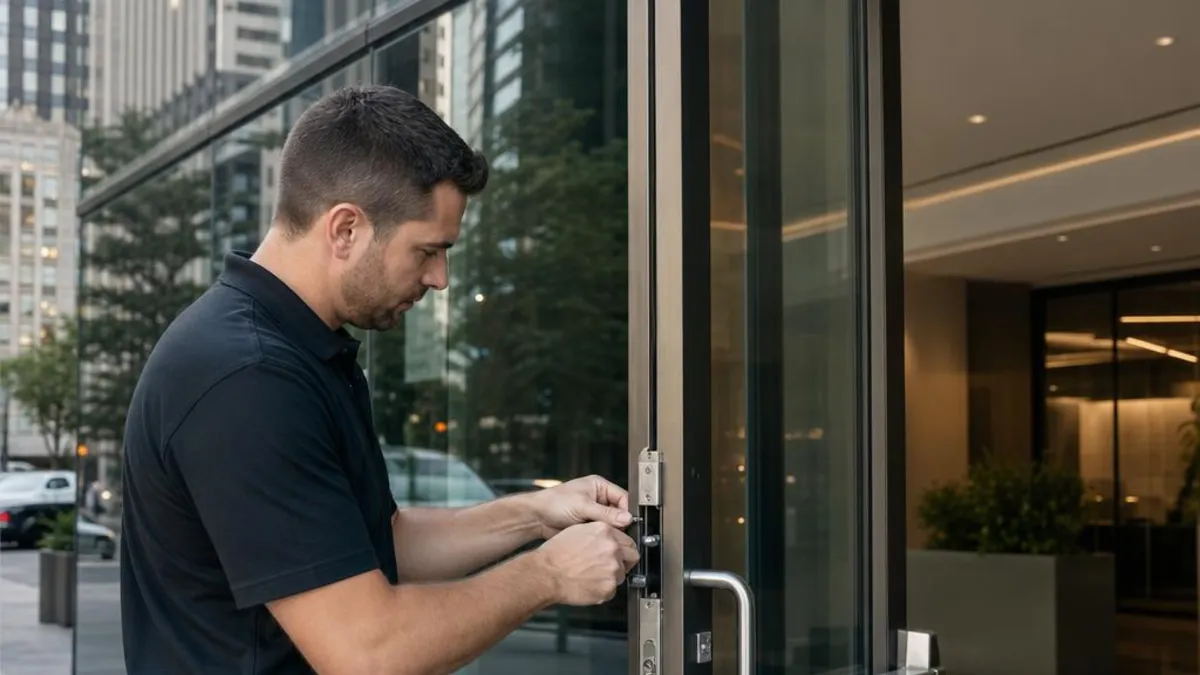
Essential Commercial Security Upgrades for Houston Businesses
Answer first: a useful commercial security plan starts with control over keys and credentials, a clear access hierarchy, compliant exit hardware, and doors and frames that actually latch. Cameras document events; locks and access control manage entry.
Key takeaways
- Restricted keyways reduce unauthorized duplication.
- Master key systems assign access by role instead of giving everyone everything.
- Electronic access control makes credential changes and audit trails easier.
- Exit hardware is a life-safety system and must permit compliant egress.
- The door, frame, hinges, and strike matter as much as the cylinder.
Start with an honest closing-time audit
Walk the property with the people who open and close it. Look at every perimeter door, shared suite entrance, receiving door, gate, roll-up door, and controlled interior room.
Ask:
- Who currently has keys or credentials?
- Can the list be verified?
- Which doors are regularly propped open because the workflow is inconvenient?
- Does every exit open freely from the occupied side?
- Which doors fail to latch unless someone pulls or pushes them?
- Where would a lost key force a broad rekey?
- Who is authorized to request duplicates?
Do not add electronics before fixing a door that drags, a closer that does not latch, or a strike that barely catches.
Upgrade priorities
| Upgrade | Problem it addresses | Strong fit |
|---|---|---|
| Restricted keyway | Uncontrolled key copying | Businesses that issue keys to staff or vendors |
| Master key system | Excess access and key-ring sprawl | Properties with different roles or departments |
| Electronic access control | Credential changes, schedules, and audit trails | Turnover, after-hours access, and sensitive rooms |
| Exit hardware service | Unsafe or unreliable egress | Any exit that sticks, latches poorly, or has improper added locks |
| Door and frame reinforcement | Forced-entry weakness | Rear, alley, warehouse, and exposed perimeter doors |
| High-security cylinders | Picking, drilling, and key-control concerns | Openings protecting sensitive inventory or operations |
The right plan may use several of these together. Review the commercial locksmith service page for current service information and contact options.
Restricted keyways
A common key blank can be copied wherever that blank is sold. Returning one issued key does not prove another copy was never made.
A restricted system controls the blanks and the people allowed to request copies. The business keeps an authorization list, and the servicing dealer checks it before cutting another key. This creates administrative control around a mechanical lock.
Restricted keyways are useful when staff, contractors, cleaners, vendors, or temporary managers receive keys. The system is only as good as its records, so assign responsibility for the authorization list and review it regularly.
Master key systems
A proper master key plan is a hierarchy, not simply one key that opens everything.
- Change keys operate assigned doors.
- Sub-master keys operate a defined group such as a department, floor, or suite.
- Grand master access is reserved for the smallest practical group.
Design the hierarchy on paper before cylinders are pinned. Include future doors and likely tenant changes so the system is not improvised each time the building grows.

Keep an issuance record showing which key identifier was provided, to whom, and when it was returned or cancelled. Do not label a key with the address or the exact room it opens.
Electronic access control
Electronic systems make sense when credentials change often, entry schedules matter, or the business needs an audit trail. Instead of mechanically rekeying after every personnel change, an administrator can disable the specific credential.
Useful capabilities include:
- Individual credentials rather than shared codes
- Time-based permissions
- Door-status monitoring
- Event history
- Remote administrative control
- Integration with alarms or business procedures
Electronic access does not replace the mechanical strength of the opening. The lock, strike, closer, hinges, frame, and emergency override all still matter. Plan for power and network interruptions, especially in a storm-prone city.

Exit hardware and life safety
Commercial egress doors generally must open from the occupied side without a key, tool, or special knowledge. Chains, padlocks, and improvised deadbolts on an exit can create a life-safety hazard even when they were added to address real theft.
Applicable requirements vary by occupancy, door, and local code. Have the opening evaluated by a qualified professional and involve the authority having jurisdiction when required. NFPA publishes life-safety standards, and the ADA Standards address accessible operation.
Panic bars, lever hardware, closers, and strikes need maintenance. A bar that sticks or a closer that fails to latch is both an operational problem and a security problem.
Houston conditions that affect the plan
Heat, humidity, and storms
Exterior doors can swell, shift, or corrode. After severe weather, inspect whether perimeter doors close and latch without being forced. A powered system cannot secure a door whose bolt misses the strike.
Multi-tenant turnover
When suites change tenants, review the key hierarchy and shared access before handing over the space. A restricted system can preserve control over common doors while the suite cylinders change.
Warehouses and yards
Roll-up doors, personnel doors beside loading bays, gate hardware, and storage cages are easy to overlook because they are not the front entrance. Include them in the same key and inspection records.
Restaurants and retail
If staff prop a rear door open for deliveries or breaks, ask why. The closer may be too aggressive, the access process may be inconvenient, or the delivery procedure may be unclear. Fix the workflow and hardware instead of relying on reminders.
Mechanical and electronic systems compared
| Factor | Mechanical master key system | Electronic access control |
|---|---|---|
| Credential | Physical key | Card, fob, mobile credential, or code |
| Removing one person's access | Recover the key or rekey affected openings | Disable that credential |
| Audit trail | No | Yes |
| Operation during power loss | Direct mechanical operation | Requires the designed backup method |
| Scheduling | No | Yes |
| Best fit | Stable access groups and straightforward openings | Changing staff, schedules, and audit requirements |
Many properties use a hybrid: electronic access where activity needs to be managed, and controlled mechanical hardware for backup or lower-traffic openings.
Choosing a commercial locksmith
Verify the company through the Texas DPS Private Security Program. Ask who owns and maintains the key records, who can authorize copies, what documentation you receive, and what happens to the records if you change vendors.
The guide to verifying a licensed Houston locksmith applies to commercial vendors as well as emergency calls.
Bottom line
Control key duplication, assign access by role, keep exit hardware compliant, and make sure the physical opening closes and latches. Add cameras as part of the plan, not as a substitute for the parts that actually control entry.
Frequently asked questions
What should a Houston business upgrade first?
Start with an audit of keys, credentials, doors, frames, strikes, and exits. Restricted key control and a clear access hierarchy often address the first administrative gaps.
When is electronic access control worthwhile?
It is especially useful when staff access changes often, schedules matter, sensitive rooms need an audit trail, or shared keys have become difficult to control.
Can a business add a padlock to an exit door?
Improvised locks can violate life-safety requirements by preventing free egress. Have the door evaluated and use code-compliant hardware suited to the occupancy and opening.
How often should commercial access be reviewed?
Review it whenever personnel, tenants, vendors, operating hours, or the physical layout changes, and whenever a key or credential cannot be accounted for.
Plan the Openings Before Buying Hardware
Call Texan Locksmith to discuss the property's doors, key control, master key needs, exit hardware, and access-control priorities.