
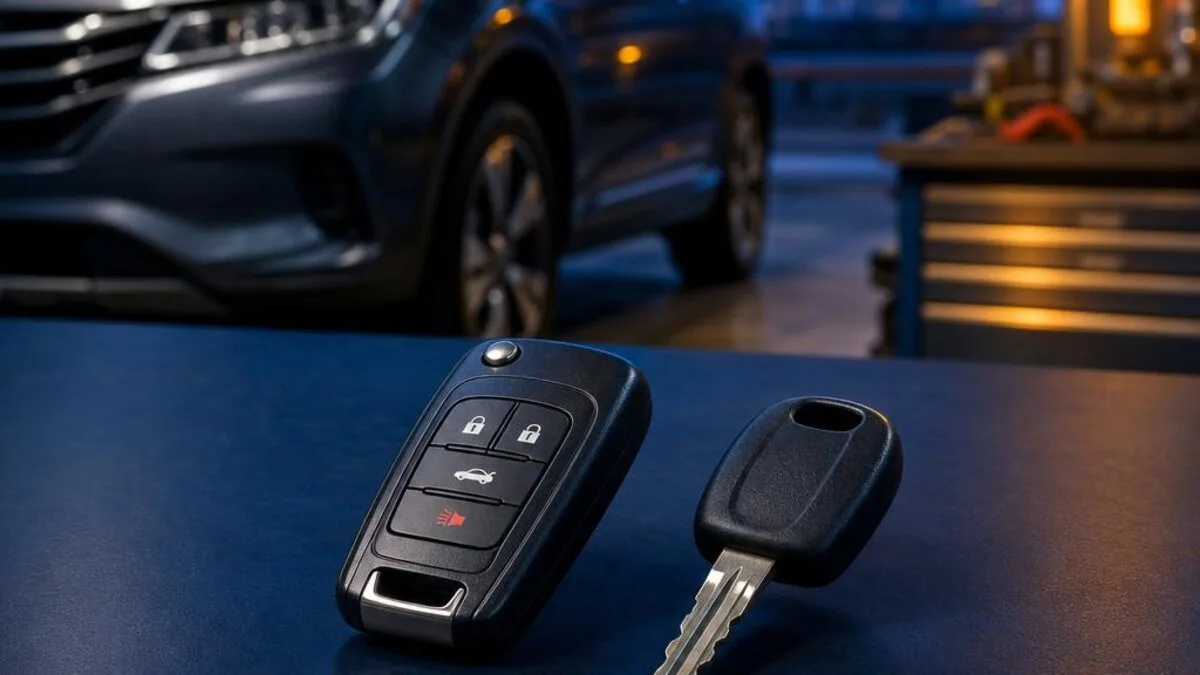
Key Fob vs. Transponder Key: What's the Difference?
Short answer: a transponder key contains a passive chip that the vehicle checks before allowing the engine to start. A key fob is a battery-powered remote used for locking, unlocking, trunk release, panic functions, and sometimes remote start. Many modern car keys combine both systems in one housing.
That distinction matters when something stops working. Dead buttons can point to the remote side, while a no-start condition can involve the transponder, immobilizer, antenna, or another vehicle system.
Key takeaways
- A transponder chip helps authorize engine start.
- A key fob sends remote commands to the vehicle.
- The two systems often share one plastic case but use different components.
- A dead fob battery does not necessarily mean the transponder has failed.
- Visual appearance alone does not confirm compatibility.

Two systems inside one key
Drivers commonly use “key,” “fob,” and “remote” interchangeably because automakers package several functions together. A remote-head key may contain:
- A mechanical blade that operates the door or ignition cylinder.
- A passive transponder chip used by the immobilizer.
- A battery-powered remote circuit for the door locks and other convenience features.
These parts can fail independently. A worn button does not automatically mean the engine-start credential is damaged. A blade that opens the door does not prove its chip is registered with the vehicle.
What is a transponder key?
A transponder key contains a small electronic chip. In many traditional ignition systems, an antenna around the ignition cylinder creates a low-frequency field that powers the passive chip. The chip responds, and the vehicle checks that response against its authorized keys.
If the vehicle does not recognize the credential, the immobilizer can prevent the engine from starting. The exact behavior varies: some vehicles crank without starting, some show a security warning, and others do not crank.
The transponder is not the same thing as the visible metal blade. A newly cut blade may operate the lock while still failing to start the engine until the correct chip is programmed.
Why chip type matters
Transponder families and security protocols differ by manufacturer, model, and year. Two key blanks may look alike and use the same blade profile while containing incompatible electronics.
That is why a provider needs the exact year, make, model, and preferably the VIN before confirming a replacement. Part numbers, chip families, frequencies, and manufacturer access requirements can all affect compatibility.
What is a key fob?
A key fob is a battery-powered radio remote. Depending on the vehicle and trim, its buttons may control:
- Door locking and unlocking
- Trunk or liftgate release
- Panic alarm
- Remote start
- Sliding doors or other equipped features
The fob sends a coded radio signal to a receiver in the vehicle. Frequency and protocol must match. A replacement shell that looks correct is not enough if the internal transmitter is incompatible.
Smart keys and proximity fobs
A smart key or proximity fob combines remote-entry functions with the credential used for push-button start. The vehicle detects an authorized key nearby and allows entry or starting without inserting a blade.
Most proximity fobs also contain a hidden mechanical emergency blade. Many vehicles provide a backup procedure for a weak fob battery, but the method varies. Check the owner’s manual rather than assuming the fob should be held against a particular location.
Key fob, transponder key, and smart key compared
| Feature | Transponder key | Remote key fob | Smart or proximity key |
|---|---|---|---|
| Primary purpose | Authorize engine start | Send remote convenience commands | Support proximity entry and push-button start |
| Typical power | Passive; energized by the vehicle | Coin-cell battery | Coin-cell battery with a model-specific backup method |
| Mechanical blade | Usually | Sometimes separate or hidden | Usually hidden emergency blade |
| Programming | Immobilizer registration | Remote pairing | Vehicle-specific security programming |
| Common symptom | Security light or no-start condition | Buttons or remote range stop working | Intermittent detection or no-key warning |
The categories can overlap. A remote-head key includes both a transponder and a remote. A proximity fob performs both roles through a more integrated system.
How to identify what you have
Look at how the vehicle starts
- A plain blade inserted into the ignition may be mechanical-only or contain a transponder.
- A thick plastic head often houses a transponder even when there are no buttons.
- Buttons indicate a remote transmitter is present.
- Push-button start generally uses a smart or proximity credential.
Check the owner’s manual and part information
The owner’s manual explains the intended starting and emergency-access procedures. The fob’s part number or regulatory identifier can help distinguish electronics that use similar shells.
Use the VIN
The VIN helps a locksmith or dealership identify the original key configuration. The physical key may still need inspection if equipment or modules were replaced during the vehicle’s life.
What different symptoms can mean
| Symptom | Possible area to check |
|---|---|
| Remote buttons do not work, but the car starts | Fob battery, worn buttons, damaged remote circuit, or lost remote pairing |
| Blade opens the door, but the car does not start | Transponder compatibility, programming, antenna, immobilizer, ignition, or another vehicle fault |
| Push-to-start vehicle reports no key detected | Fob battery, fob damage, antenna, interference, programming, or vehicle electrical issue |
| Remote range has become shorter | Weak battery, interference, damaged fob, or receiver issue |
| One key works and another does not | Key-specific battery, chip, compatibility, or programming issue |
These are diagnostic starting points, not a guaranteed conclusion. A weak vehicle battery, damaged wiring, failed antenna, or module fault can imitate a key problem.

What replacement involves
Mechanical cutting
The replacement blade must match the vehicle’s lock. Traditional edge-cut blades and high-security sidewinder blades require different cutting equipment.
Transponder programming
The replacement chip must be compatible and registered with the immobilizer. The procedure may use the diagnostic port, a manufacturer-authorized security process, or a model-specific method.
Remote pairing
The lock and trunk buttons may require a separate pairing step from the engine-start credential. Test every expected function before the service is complete.
All keys lost
When no working key remains, the job may require key origination, security access, and a different programming procedure. Ask whether missing keys can and should be removed from the vehicle’s memory.
The 2026 Houston car key replacement cost guide explains the factors that shape a complete estimate.
Common mistakes to avoid
- Buying only by appearance. Similar shells can contain incompatible electronics.
- Assuming cutting is the whole job. A transponder key may open the door but not start the engine until programmed.
- Replacing the fob before testing the battery. Reduced range and intermittent buttons can begin with a weak coin cell.
- Waiting until every working key is lost. Making a spare while one key remains is often more straightforward.
- Keeping the spare inside the vehicle. A spare cannot help if it is locked in the car.
- Skipping ownership and license checks. Vehicle-key work should be performed by a verifiable provider.
Security considerations
Have government-issued photo identification and accepted proof of ownership or authorization ready. A legitimate provider should confirm that the vehicle and documentation match before creating or programming a key.
If a key was stolen, ask what the programming procedure can remove from memory. Electronic deletion may stop a missing credential from starting the vehicle, but a mechanical blade may still fit a door lock.
Texas regulates locksmith businesses through the Department of Public Safety Private Security Program. Texan Locksmith operates under Texas license B17854701. The guide to verifying a licensed Houston locksmith provides a practical checklist.
When to use a locksmith or dealership
A qualified mobile automotive locksmith can often cut and program supported keys where the vehicle is parked. This can be especially practical when every key is lost and the car cannot be driven.
The dealership may be the appropriate route for warranty or recall work, manufacturer-restricted systems, and faults involving the immobilizer, body control module, antenna, ignition system, or another vehicle component.
Review dealership versus mobile locksmith car key programming for a complete comparison. For supported vehicles, the Houston car key replacement service covers mobile cutting and programming options.
Bottom line
A transponder key and a key fob are not the same component. The transponder helps authorize engine start; the fob controls remote features. Because automakers often combine them, the correct replacement must match the blade, chip, frequency, and security procedure for the exact vehicle.
Frequently asked questions
Is a key fob the same as a transponder key?
No. A transponder key uses a passive chip as part of engine-start authorization. A key fob is a battery-powered remote for functions such as locking, unlocking, trunk release, and remote start. Many modern keys combine both systems in one housing.
Can a car start if the key fob battery dies?
Often, but the result and backup procedure depend on the vehicle. A traditional transponder may not rely on the remote battery. Push-to-start vehicles commonly provide a backup detection method described in the owner’s manual.
Why can a newly cut transponder key open the door but not start the car?
The mechanical blade and electronic credential are separate. The blade can match the lock while the chip is incompatible or not registered with the immobilizer.
Can a locksmith replace a smart key or proximity fob?
For many vehicles, yes. The provider should confirm the exact year, make, model, part compatibility, and programming access before dispatch. Some restricted systems or vehicle faults may require dealership service.
What information is needed for key fob or transponder replacement?
Provide the year, make, model, trim, VIN, key style, and whether any working key remains. You will also need accepted photo identification and proof that you own or are authorized to use the vehicle.
Need Help Identifying Your Car Key?
Call Texan Locksmith with the vehicle year, make, model, VIN, key style, and symptoms. Ask whether the exact transponder, remote, or smart-key system is supported before scheduling service.